How Horse Owners Define Equine Welfare, Wellbeing, and Quality of Life
A qualitative study of 21 UK leisure horse owners found that words like "welfare," "wellbeing," and "quality of life" mean very different things to different people — and that horse owners assess their animals through a deeply personal lens that no checklist fully captures.
Ask ten horse owners whether their horse has good welfare, and you will likely get ten different answers — even if those horses are living remarkably similar lives. That gap between scientific definitions and lived experience is not a failure of horse ownership. It is, according to a study from the University of Liverpool, a fundamental feature of how humans understand and communicate about animal wellbeing.
This research, published in Animals in 2022, is one of the first studies to systematically explore how horse owners define equine welfare and wellbeing in their own words — not as researchers or professionals frame it, but as it lives in daily barn life. The findings have significant implications for anyone trying to improve equine welfare through education, veterinary communication, or public outreach.
Overview
Researchers conducted four online focus group discussions with 21 leisure horse owners across the UK, recruited through social media and targeted outreach. Participants ranged widely in experience, kept horses for different purposes (competition, hacking, retirement, companion), and were housed in various settings from private fields to full livery. A fourth focus group was deliberately composed of male participants only, to explore whether gender influenced how wellbeing was discussed.
Each session ran for approximately 90 minutes and had two parts. In the first, participants were asked open questions about their experiences thinking about their horse's wellbeing — unprompted, in their own words. In the second, they were presented with seven specific terms — welfare, wellbeing, quality of life, happiness, good life, best life, and life worth living — and asked to compare and discuss them.
Data were analyzed using constructivist grounded theory, a qualitative method that builds understanding from participants' own frameworks rather than imposing categories from the outside. A content analysis was also conducted to track how frequently each term appeared and in what contexts.
Key findings: How horse owners define equine welfare and wellbeing
Horse owners do not use welfare terminology consistently — and that is not necessarily a problem. The same word meant different things in different conversations, and even different things within the same conversation. "Welfare" was used to describe everything from minimum legal standards to positive flourishing. "Happiness" appeared most often not as a positive state but through its absence — owners described horses as "not happy" far more readily than as "happy." Despite this variation, participants understood each other perfectly well — the researchers describe this as a kind of "mutual intelligibility," where shared context compensates for imprecise language.
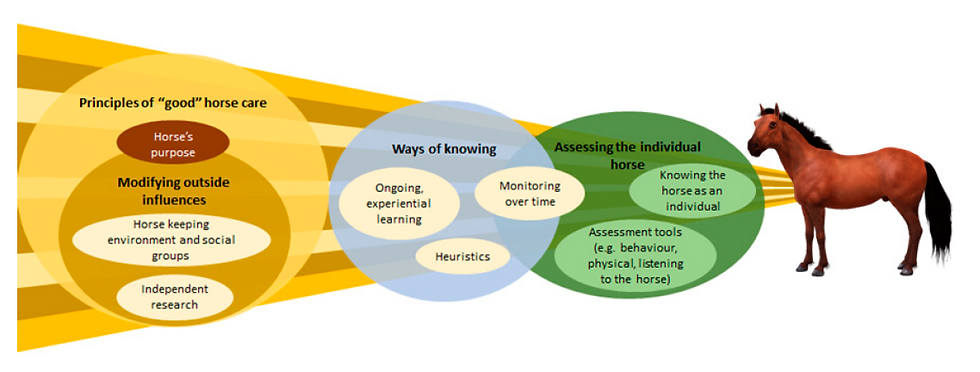
Wellbeing assessment is ongoing, informal, and deeply individualized. When asked about a specific time they had thought about their horse's wellbeing, many participants simply said "every day" or "all the time." Assessment was not a discrete event — it was woven into every interaction, observation, and care decision. Owners drew on four interlocking sources of understanding: their principles of good horse care, outside influences (peers, social media, yard culture), their ways of knowing (experience, monitoring over time, heuristics), and their intimate knowledge of their individual horse.
The horse's purpose shapes what "good welfare" looks like. A competition horse kept in a strict stable routine was evaluated differently from a retired companion in a field. Owners understood that discipline norms created different expectations, and that what constituted acceptable welfare in one context might be considered problematic in another. This means welfare is not assessed against an absolute standard but against a contextual one — which has real implications for how welfare education lands with different audiences.
Knowing your horse can sometimes blind you to their suffering. One of the most striking findings in the study was the account of an owner who had kept a horse for ten years and believed she knew him completely — only to discover, after treating him for ulcers, that behaviors she had attributed to his "typical thoroughbred personality" were actually signs of chronic pain. The transformation was described as remarkable. This case illustrates a genuine risk: that deep familiarity with an individual horse can normalize pain-related behavior, leading owners to attribute it to personality rather than pathology.
Owners focus more on avoiding negative welfare than promoting positive welfare. Across the focus groups, the most common welfare threshold was essentially "nothing is obviously wrong." Stereotypic behaviors, lameness, and distress were markers that something had crossed a line — but positive emotional states, enrichment, and flourishing received less attention. This aligns with the current direction of welfare science, which is moving toward a "life worth living" framework that actively promotes positive experience rather than merely preventing suffering. The gap between that scientific aspiration and everyday owner practice represents a real opportunity for education.
Formal welfare tools and checklists were neither used nor wanted. None of the participants described using structured welfare assessment tools, and most described their own monitoring processes as more nuanced and dynamic than a checklist could capture. This is a significant finding for anyone developing welfare resources: a tick-box approach may feel reductive to owners who already believe they are conducting sophisticated, ongoing welfare assessments.
Social groups shape welfare beliefs powerfully — sometimes in ways that resist evidence. Participants described online communities organized around specific care philosophies — barefoot keeping, 24/7 turnout, natural horsemanship — where welfare beliefs were socially reinforced and validated. While these communities can support good practice, they can also entrench approaches that are resistant to veterinary or scientific guidance, particularly when participants describe losing confidence in vets whose advice conflicted with their group's norms.
How to apply this in your riding and training
Recognize that your welfare baseline is personal — and test it. Every owner builds a reference point for what "normal" looks like for their horse. That reference point is valuable, but this study shows it can also create blind spots. Periodically asking yourself whether a behavior you've accepted as personality might instead be pain is one of the most important welfare habits you can develop. If your horse has always been "a bit funny about being groomed" or "just not a people horse," it may be worth asking a vet whether that history warrants a clinical look.
Understand the difference between welfare and wellbeing — and aim higher than the floor. This study found that owners often use "welfare" to mean minimum acceptable standards and "wellbeing" to mean something richer. That intuition is worth following. Meeting the minimum is not the goal. If the question you are asking is "is my horse suffering?" you are setting the bar too low. The better question is "is my horse experiencing positive states — curiosity, relaxation, social connection, enjoyment of movement?"
Know where your welfare beliefs come from. Yard culture, online communities, and peer groups all shape what owners believe is normal and acceptable. That is not inherently problematic — community knowledge is often valuable. But it is worth asking whether your reference group is expanding your understanding or confirming it. Seeking out perspectives that challenge your assumptions — including from vets, equine behaviorists, and welfare researchers — is part of good horse ownership.
Checklists are a floor, not a ceiling. The participants in this study were right that their own assessments were more nuanced than a welfare checklist. But checklists serve a purpose: they ensure you are not accidentally skipping basics in the flow of daily routine. Use them as prompts, not substitutes for the ongoing, individualized observation this study describes.
When talking to your vet about your horse's quality of life, be explicit. This study found that even people with legal expertise used welfare language loosely in everyday conversation. Your vet may mean something quite precise when they use terms like "quality of life" or "welfare concern" — and you may mean something different. Asking for clarification, and sharing your own framework for what a good life looks like for your specific horse, leads to better conversations and better decisions.
Read the study
Smith, R., Furtado, T., Brigden, C., Pinchbeck, G., & Perkins, E. (2022). A qualitative exploration of UK leisure horse owners' perceptions of equine wellbeing. Animals, 12(21), 2937. https://doi.org/10.3390/ani12212937


Comments